Home » Excel in Product Development: Why the Spreadsheet Model Hinders R&D Excellence » The 2027 R&D Roadmap: Planning Certainty Instead of a Nail-Biter
In mid-December, every roadmap looks good. The projects have been prioritized, the launch dates have been finalized, and management is satisfied.
By mid-March, that same roadmap looks different. A supplier has changed the specifications. A customer suddenly wants less sugar. And the colleague who knows the basic recipe best won't be in the office for three weeks.
Does this sound familiar? If so, it’s probably not because of your planning. Rather, it’s due to an assumption on which almost every R&D roadmap is based: that your team’s time is available for development.
In this post, you'll see where this time is actually being wasted, why 2027 is particularly significant, and which four building blocks will make your roadmap robust. At the end, you'll find a short self-assessment for your roadmap.
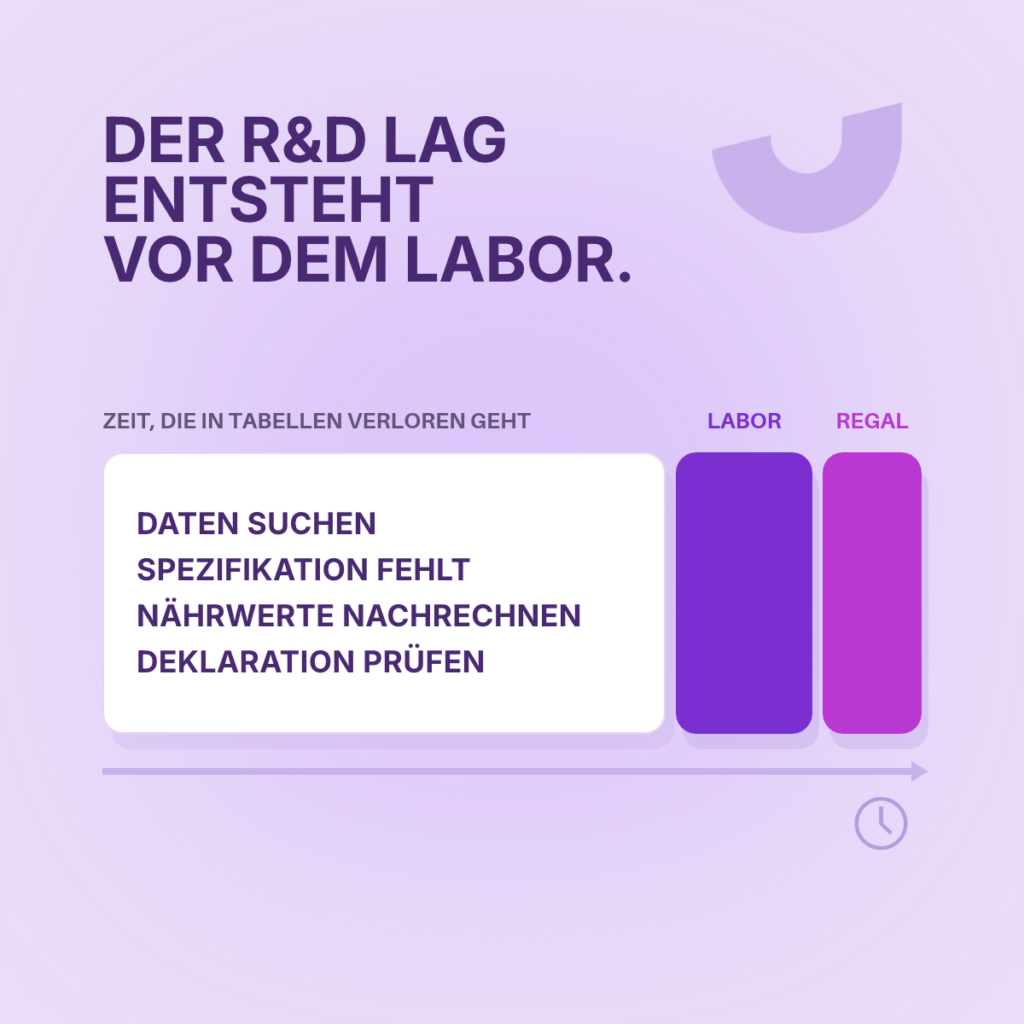
If you look at a development project in reverse, you'll rarely find the delay in the lab. It lies in the steps that come before it:
Each of these steps takes only a few hours. Taken together, they create the R&D lag: the costly gap between idea and store shelf. It lurks in buffers, coordination rounds, and sample runs that become necessary only because a piece of information arrived too late.
Next year, the R&D Lab will have two external events that do not align with your lab's schedule.
Sugar Tax on Beverages: On November 10, leaders of the CDU/CSU and SPD agreed to introduce the sugar tax on January 1, 2028—half a year later than previously planned (Euronews). According to Lebensmittel Zeitung, three tiers are planned: 25 cents per liter for beverages containing 5 g or more of sugar per 100 ml, 30 cents for 7 g or more, and 35 cents for 9 g or more. The law has not yet been passed. For beverage manufacturers, 2027 will therefore be the year of reformulation.
EU Deforestation Regulation (EUDR): According to the amended Regulation (EU) 2025/2650, the EUDR will apply to large and medium-sized enterprises starting December 30, 2026, and to most micro and small enterprises starting June 30, 2027 (European Commission). Among other products, cocoa and coffee are affected. Origin data must then be clearly traceable to each affected recipe.
Both tasks involve the steps that come right before the lab: recalculating formulas, assigning raw material data, and comparing variants. Anyone who wastes days on this now will waste twice as many in 2027.
The obvious response to tight deadlines is to build in larger buffers. But that doesn't make a roadmap more reliable—it just slows it down. The R&D lag remains; it just gets more leeway.
The roadmap will only become more reliable once the work that isn't development is removed from the critical path.
For your roadmap, this means: The biggest time savings in 2027 will come from the steps taken before the lab. If you start there, you won’t just be catching up with a trend—you’ll be gaining time.
For each of the four time-wasters listed above, there is a building block that removes it from the critical path.
1. Against Searching: Knowledge You Can Find in Minutes. “Have we developed something like this before?” This question should be answered in minutes, not after two days of searching through folders and email inboxes. Empirical knowledge that exists only in people’s minds or in individual files poses a risk to any planning process.
2. To avoid duplicate data entry: Raw material data is entered only once. Specifications should be entered in a structured format once and then reused in every formula. If a supplier makes a change, you’ll immediately see which products are affected. As a bonus, this also lays the groundwork for your EUDR documentation.
3. Avoiding the need for recalculations: Variants that are decided on screen. What happens to nutritional values, costs, and Nutri-Score if you reduce the sugar content by 20%? If this is calculated before the first batch of samples is produced, every variant that is discarded saves a lab test. For sugar tax reformulation, this is the key lever.
4. Avoiding Follow-Up Questions: Briefings that are complete from day one. Target costs, claims, exclusions, procedures, shelf life: If these points are clarified at the start of the project, the number of revision cycles decreases significantly.
A quick test will show you how far your own planning is from these four building blocks. Answer the five questions spontaneously with “Yes” or “No”:
More than two "no"s? Then your roadmap involves more risk than the timeline suggests.
With discipline, these four building blocks can also be implemented in Excel. However, they will only be effective in the long run if data, recipes, and knowledge are all consolidated in one place.
This is exactly where the UMYNO Suite comes in. It is an AI workspace for R&D in the food and beverage industry that consolidates fragmented knowledge—specifically, recipe-specific data and critical know-how—into a central, AI-ready dataset. AI captures and maintains supplier specifications and raw material data; recipes can be compared and verified with AI support; and new product requirements are recorded as digital briefings. This removes non-development work from the critical path of your roadmap.
What a CRM is to sales, the UMYNO Suite is to your product development. If you'd like to see how this could work for your team, please contact us—we'd be happy to set up a personalized one-on-one executive demo.
No More Slow Food Developments.
Schedule a free, no-obligation consultation today.

