Home » Excel in Product Development: Why the Spreadsheet Model Hinders R&D Excellence » First the Foundation, Then AI: A Strategic 3-Step Roadmap for Smart Food Product Development
“We need something with AI right now!”—this phrase is currently shaping countless strategic discussions on AI in food product development. Roadmaps in executive suites almost always focus prematurely on highly complex applications at the end of the value chain: autonomous agents, intelligent co-pilots, or fully automated recipe optimization at the push of a button. The focus is fixed squarely on the final application level.
Successful digital transformation in the lab is neither a reckless leap forward nor a mere
investment in expensive software tools. It is a logical, evolutionary development. Before a system
can make intelligent suggestions, a fundamental—and often uncomfortable—governance question
must be answered: “Who actually owns and maintains the underlying data?” Without this
clarification, any AI initiative remains an incalculable economic risk.
In R&D, algorithms rarely fail due to their mathematical complexity, but rather because of the quality
and structure of the input data. While generative AI in marketing works seamlessly with unstructured
data and is tolerant of statistical uncertainties, food technology does not tolerate errors. A
incorrect nutritional value or a misinterpreted allergen matrix leads directly to a massive
compliance and liability risk.
A true gain in efficiency can only be achieved when data can be analyzed using standardized technology.
To do this, companies must do their homework and follow a clear technological sequence
that serves as a strategic roadmap:
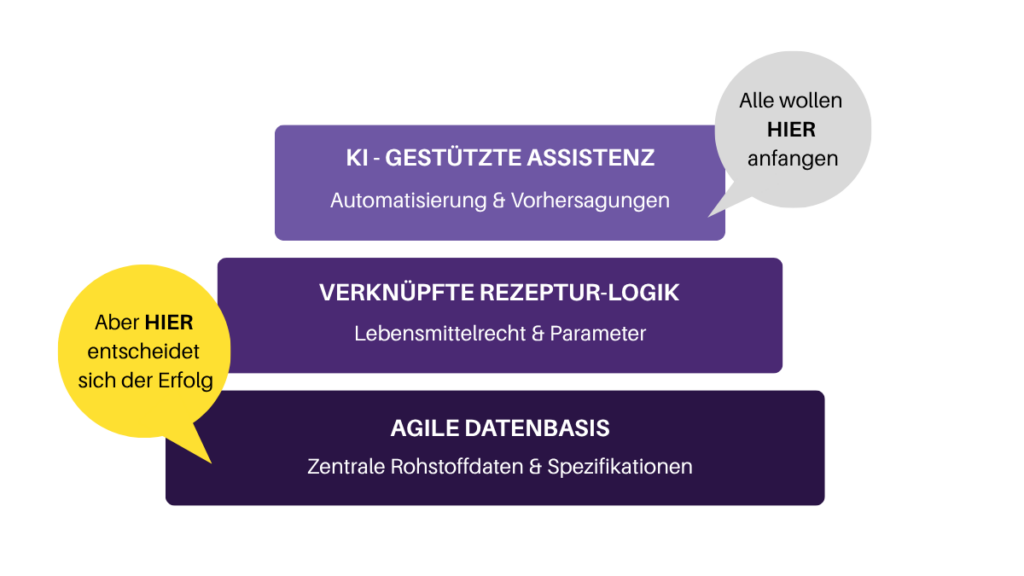
The takeaway is this: “Data-First” is not merely an IT project. It is a strategic
management decision. Digital transformation in the lab cannot be forced through a linear
giant leap. It is a logical evolution that must necessarily follow a technological sequence
in three clear stages:
With UMYNO’s customized Worksuite, we specialize in seamlessly putting these three stages of AI-driven food product development into practice. We ensure that digitalization in the lab does not remain an abstract, obstructive IT project, but instead becomes a real, tangible lever for your daily value-adding work. The result is a structured data architecture that serves as a stable foundation for genuine, scalable innovation.
Schedule a free, no-obligation consultation today.
The path to smart product development inevitably requires a clean data architecture. Those who neglect their work in stages 1 and 2 risk making poor investments and dangerous miscalculations. Only by systematically linking data and logic can you ensure the future viability of your products, minimize administrative overhead, and turn R&D into a true, digitized powerhouse for your company.

