Home » Excel in Product Development: Why the Spreadsheet Model Hinders R&D Excellence » Agility or Stagnation: What the Food Industry Can Learn from the Hype Surrounding the Dubai Chocolate
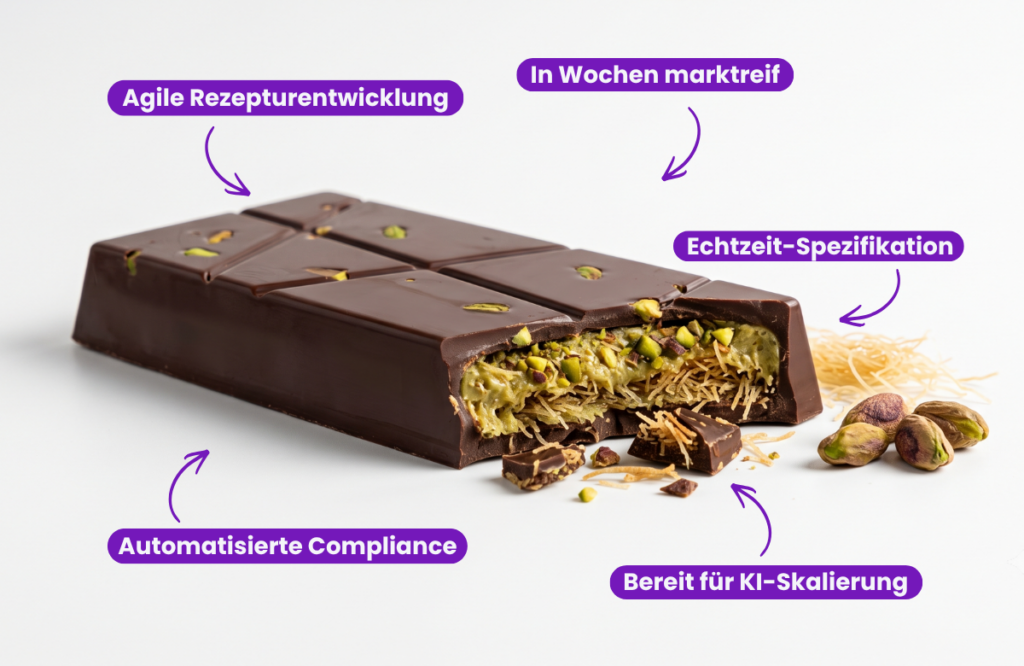
Did you take advantage of that window of opportunity? When the hype surrounding Dubai chocolate reached the European market, the confectionery industry saw the wheat separated from the chaff. While some agile manufacturers had their products on store shelves within a few weeks with tailored concepts, others were still debating raw material specifications and recipe variations in isolated spreadsheets.
At this year’s Ice Forum, Prof. Dr. Christian Klein, founder of UMYNO, made it clear in his presentation: This so-called “slow mover effect” is no coincidence. It is the result of a structural shortfall in research and development.
Trends in the food industry today follow an extremely steep curve. Market analyses show that the critical window of opportunity for capturing the market is often just three months . Those who fail to deliver during this phase leave the field open to agile competitors without a fight.
But why does R&D often lag behind in terms of speed? A recent Bitkom study reveals a drastic technological imbalance within companies:
As a result, R&D is in danger of becoming the technological laggard in industrial value creation.
The problem in laboratories is rarely a lack of creative ideas. It is the misallocation of expert resources. In a traditional R&D environment, highly qualified food technologists spend up to two hours a day on purely administrative tasks.
This leads to the far-reaching 90/10 paradox:
We employ the brightest minds in the industry to manage data in spreadsheets instead of inventing products that could dominate tomorrow's market.
One key statement from Christian Klein's keynote speech has particularly stuck with me:
"Excel is not a database for AI."
In many laboratories, Excel remains the go-to tool for formula calculations, Nutri-Score optimizations, and clean-label strategies. However, spreadsheets cannot account for multidimensional dependencies. Changing a single ingredient simultaneously affects costs, sensory characteristics, labeling, and regulatory compliance.
Anyone who checks these interdependencies manually in isolated data silos will reach human limits given today's flood of data. AI can serve as a digital assistant in this context, enabling R&D teams to act more quickly again.
However, artificial intelligence can only provide effective support if the IT infrastructure is in place.
The transformation of the R&D infrastructure is not an “all-or-nothing” scenario, but rather a strategic, step-by-step process:
Automation of routine tasks, document filing, and standardized nutritional calculations. |
Predictive systems that serve as creative sparring partners and generate data-driven formulation suggestions based on current market trends to inspire product development. |
Fully integrated systems that serve as a digital backbone, seamlessly connecting the entire value chain—from concept to scaling—so that teams can bring projects to market with unparalleled efficiency. |
The complexity of modern product development—whether due to the physical challenges of ice cream production or regulatory pressure to optimize Nutri-Score ratings—makes it nearly impossible to manage these tasks error-free using manual methods alone. By automating these routine tasks, we free up the time our experts need to focus on actual innovation.
Coupled with rapid trend cycles—such as those seen with Dubai chocolate—the professionalization of the R&D infrastructure is becoming the most important strategic lever.
It's time to transform R&D from the blind spot of digital transformation into a strategic powerhouse for your company.
Schedule a free, no-obligation consultation today.

